

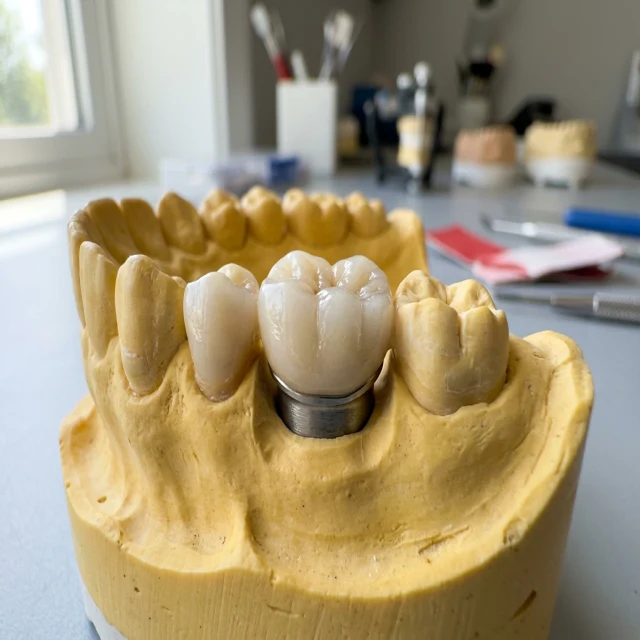
A single missing tooth seems like a small problem until you see what happens around it. Adjacent teeth start to drift toward the gap within months. The tooth in the opposite jaw over-erupts because nothing is pushing back against it. The jawbone under the empty space begins to shrink within weeks. A single-tooth dental implant replaces the lost tooth from root to crown so the bite stays where it belongs and the bone stays put. At our Beaverton office we plan and place single-tooth implants in-house using CBCT 3D imaging and a custom surgical guide for precise placement. Most patients return to work the day after surgery.
What is a single-tooth dental implant?
A single-tooth dental implant replaces one missing tooth with a titanium post placed in the jawbone and a custom crown on top. The implant fuses to bone over 3–6 months (osseointegration) before the final crown is attached. Total cost typically ranges from $3,500 to $6,000 at our Beaverton office. CBCT 3D imaging and a consultation determine candidacy in a single visit.
Who single-tooth implants are for
Most adults missing a single tooth are candidates. We confirm fit at consultation with a CBCT scan, a brief medical history review, and a look at the surrounding bone and gum tissue. Typical candidates include:
- Adults missing one tooth from decay, fracture, periodontal disease, or trauma
- Patients with a single failing tooth that cannot be saved by root canal or crown
- Patients with adequate jawbone — or candidates for bone grafting before placement
- Generally healthy adults; uncontrolled diabetes, active periodontal disease, or certain medications require evaluation
- Smokers can be candidates, but the published failure rate is higher and we discuss the trade-offs honestly
If you are not sure whether you qualify, a consultation with CBCT imaging usually answers the question in a single visit.
Why a single missing tooth still matters
A gap from one missing tooth is easy to ignore, especially when it is in the back of the mouth and nobody else can see it. The problem is that the mouth does not stay still around the gap. Several things start happening soon after the tooth is gone:
- Adjacent teeth drift into the empty space, often within a few months. This changes the bite and creates spots that are harder to clean.
- The opposing tooth over-erupts because nothing in the opposite jaw is pushing back against it. Over time it loses its occlusal contact and can become loose.
- Jawbone shrinks under the gap. Bone needs the stimulation of chewing forces transmitted through a tooth root to stay dense. Without that signal, bone resorbs — beginning within weeks of tooth loss.
- The bite shifts. Drift and over-eruption together change how the teeth meet. Some patients develop jaw-joint (TMJ) symptoms as the bite reorganizes itself.
- Cosmetic effects show up faster in the front of the mouth, but back-tooth loss eventually affects facial contour as bone volume drops.
The longer the gap is left untreated, the more complex and expensive future treatment becomes. Replacing the tooth early is almost always less work than restoring a drifted bite and rebuilding lost bone later.
Single implant vs. the alternatives
An implant is not the only way to replace a single missing tooth. A traditional bridge, a resin-bonded “Maryland” bridge, a removable partial denture, and doing nothing are all on the table at consultation. The right choice depends on the location of the tooth, the condition of the neighbors, your timeline, and your budget.
| Option | Pros | Cons |
|---|---|---|
| Single implant + crown | Preserves adjacent teeth; restores full chewing function; maintains jawbone; can last decades | Higher upfront cost; 3–6 month timeline; requires adequate bone |
| Traditional 3-unit bridge | Faster (usually 2–3 weeks); no surgery | Requires grinding two healthy adjacent teeth as anchors; bone still shrinks under the gap |
| Resin-bonded (“Maryland”) bridge | Minimal preparation of adjacent teeth | Less durable; generally not suitable for back teeth |
| Removable partial denture | Lowest upfront cost; no surgery | Bulky; removable; bone still shrinks; usually a short-term solution |
| Leave the gap | No immediate cost | Drift, over-eruption, and bone loss make future treatment more complex and expensive |
We walk through these options at the consultation. There is no one right answer for every patient.
How a single-tooth consultation works
The first visit is a planning visit, not a procedure. You leave with a written treatment plan and a clear understanding of timeline, options, and cost before any surgical decision is made.
- CBCT 3D scan plus an intraoral scan (a digital impression that replaces traditional putty)
- Treatment-planning conversation covering placement strategy, restorative options, and recovery
- Medical history review to flag any candidacy concerns
- Written treatment plan and cost estimate provided before any procedure begins
- Insurance verification and financing options reviewed
Plan on 60 to 90 minutes for the first visit. Same-day consultations are often available.
Technology we use
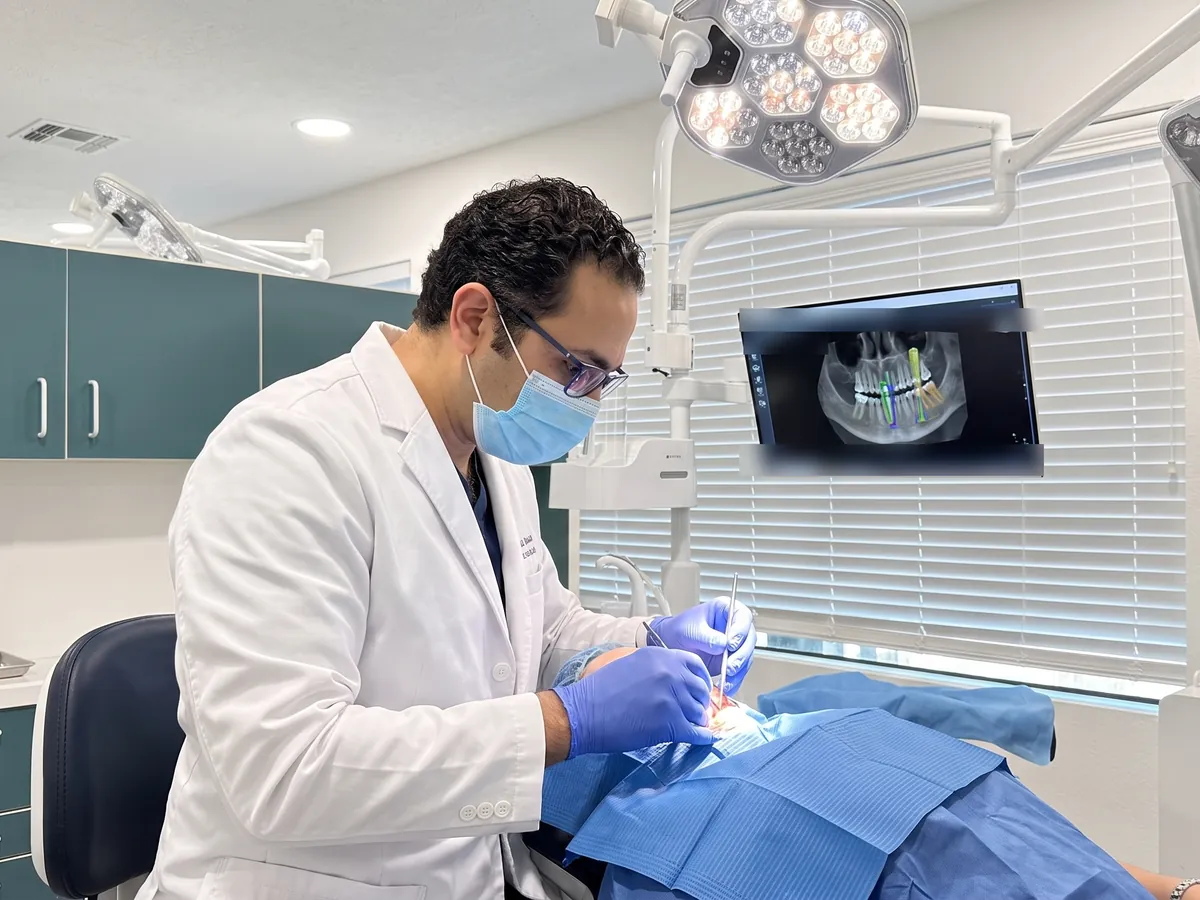
Single-tooth placement is as much a planning problem as a surgical one. The right tools shorten chair time and lower the risk of surprises.
- CBCT 3D imaging. Captures jawbone, sinus, and nerve anatomy in three dimensions. We plan implant position around your actual anatomy, not a two-dimensional approximation.
- Guided surgery software. The CBCT scan drives a digital plan; a printed surgical guide carries that plan into the operatory so the implant lands where it was designed to.
- Intraoral scanners. Replace traditional impression material with a digital scan. Faster, cleaner, and more accurate for crown fit.
- 3D-printed surgical guides. Custom-fabricated for each case from the digital plan.
- IV sedation. Administered by a certified provider, monitored throughout. An option for longer procedures or for patients with significant anxiety.
- Same-day temporary crowns when bone quality and primary stability allow it.
Sedation and comfort options
We match the sedation method to the procedure length, your medical history, and your anxiety level. Options include:
- Local anesthesia. Standard with every surgical visit.
- Nitrous oxide. A light inhaled anesthetic that wears off quickly and lets you drive yourself home.
- Oral sedation. A pill taken before the appointment; helpful for moderate anxiety.
- IV sedation. A deeper level of sedation with a certified provider monitoring vitals. Most patients have no clear memory of the procedure afterward.
For most single-tooth placements local anesthesia is enough. We discuss the right choice with you at the consultation.
Cost, insurance, and financing
Single-tooth pricing depends on the specifics of your case. The ranges below are typical for the Beaverton area; your written estimate will reflect your specific anatomy, materials, and any preliminary work.
- Single-tooth implant complete (implant, abutment, and crown): typically $3,500–$6,000, depending on bone quality, crown material (zirconia vs. porcelain-fused-to-metal), and whether the tooth is in the front of the mouth (higher aesthetic complexity) or the back.
- Bone grafting (when needed): typically $400–$2,500 depending on the extent of the graft.
- Insurance. Most dental plans cover roughly 50% of the crown portion, and many cover a portion of the surgical phase. We verify your specific benefits before treatment.
- Financing. CareCredit and in-house payment plans are available.
Quoted ranges are typical. Your consultation produces a specific written estimate based on your case.
Recovery and timeline
Most patients are surprised by how routine the recovery feels. The longest part of the timeline is the part you cannot feel — bone fusing to the implant.
- Placement appointment: 1 to 1.5 hours.
- Initial healing: 5 to 7 days of mild soreness, usually controlled with over-the-counter pain medication.
- Osseointegration (bone fusing to the implant): 3 to 6 months. A healing cap sits at the gum line during this period; a temporary crown is sometimes possible when the tooth is in a visible area.
- Crown appointment: a separate visit after we verify with an X-ray that osseointegration is complete.
- Return to work: most patients return to work the day after surgery.
- Total timeline: 3 to 6 months for most single-tooth cases from placement to final crown.
Risks and limitations
Implants are predictable, but no surgical procedure is risk-free. We discuss these openly at consultation.
- Implant failure. Uncommon; published literature reports failure rates in the low single digits, with higher rates in smokers and in patients with uncontrolled diabetes.
- Infection at the surgical site. Uncommon with proper aftercare.
- Sinus or nerve proximity. Mitigated by CBCT planning; this is the main reason we do not place implants without a 3D scan.
- Time commitment. 3 to 6 months total from placement to final crown for most cases.
- Cost. Higher upfront than a bridge or partial denture, though long-term cost can be comparable or lower.
- Candidacy. Not every patient qualifies without preliminary work such as bone grafting or treatment of active gum disease. Smokers face higher failure rates, which we discuss honestly.
Why patients choose Aloha Dental Specialty Center for single-tooth implants
There are several implant offices in the Beaverton area. A few things distinguish ours.
- A multi-disciplinary team under one roof. Three general dentists place implants within general-practice scope. Our board-certified endodontist, Specialized Endodontic Care, consults when the failing tooth has had prior root canal work or anatomical complexity that affects extraction planning.
- In-house CBCT 3D imaging. You do not need a referral to a separate imaging center for your scan.
- Same-day consultations including CBCT and a written treatment plan.
- IV sedation in-office with a certified provider.
- A local, family-run practice. Not a corporate chain. You see the same doctor at every visit.
Where we are and who we serve
Address: 18455 SW Alexander St, Suite B, Beaverton, OR 97006
Phone: (503) 822-0096
Hours: Monday–Friday 8am–5pm (6pm Thu–Fri), Saturday 8am–2pm, Sunday closed
We see patients from across the Tualatin Valley region:
- Beaverton, Aloha, Hillsboro
- Cedar Hills, Bethany, Tanasbourne, Orenco Station
- Forest Grove, Cornelius
- Tigard, Sherwood, Tualatin
- Lake Oswego and West Linn
For broader implant information, see our dental implants hub or the Beaverton dental implants page.
Frequently asked questions about single-tooth implants
No. That’s a major advantage of an implant over a bridge — we don’t touch adjacent healthy teeth. With a 3-unit bridge, we’d have to grind down the 2 adjacent teeth as anchors. The implant stands alone.
You’re a good candidate. We extract the remaining root + place the implant either same-day (immediate placement) or 3-4 months later depending on bone condition and infection status.
Implant is the better long-term choice for most patients because it preserves adjacent teeth and maintains jawbone. Bridge is sometimes preferred when: adjacent teeth already need crowns (so grinding them isn’t a sacrifice), patient can’t wait 3-6 months, or bone grafting would be required for the implant. We discuss the trade-offs at consultation.
Sometimes. “Same-day teeth” (immediate loading) is possible when bone quality is excellent and the implant has strong primary stability. Usually we place a temporary crown the day of surgery and the final crown 3-6 months later after osseointegration.
We can extract the failing tooth and place the implant in the same visit (immediate placement) in many cases. When the tooth has active infection or significant bone loss, we extract first, let the site heal 3-4 months, then place the implant. CBCT scan determines the right path.
The implant itself often lasts a lifetime in healthy patients. The crown attached to it may need replacement at 10-15 years. Published implant survival rates exceed 95% over 10 years.
Most dental insurance covers approximately 50% of the crown portion. Many cover a portion of the surgery. We verify your specific benefits before treatment and provide a written estimate.
The titanium implant surface bonds to your jawbone over 3-6 months. You won’t feel anything different during this period. We typically place a healing cap (gum-line) so your gum tissue can form around the implant. Once we verify osseointegration with an X-ray, the final crown attaches.
Schedule your single-tooth implant consultation
Same-day consultations are often available. Call (503) 822-0096 to schedule a visit at our Beaverton office. The consultation includes CBCT 3D imaging and a written treatment plan so you can decide on the next step with full information.
Related pages:
What Our Beaverton Patients Ask About Single-Tooth Dental Implants in Beaverton, OR
At Aloha Dental Specialty Center, patients frequently ask about the timeline, cost, and recovery for Single-Tooth Dental Implants in Beaverton, OR. Dr. Walied Eldomiaty personally reviews each case using CBCT 3D cone-beam imaging to develop an individualized treatment plan. Most procedures are completed in one to two visits, with IV sedation, oral sedation, and nitrous oxide available for your comfort. We accept Delta Dental, Cigna, Aetna, MetLife, Guardian, and most PPO plans, with CareCredit 0% financing for 12-24 months. Recovery varies by case complexity — our team provides detailed written aftercare instructions and schedules follow-up visits. Questions? Call (503) 822-0096 — we’re open 8 AM – 5 PM weekdays (until 6 PM Thursday and Friday) and Saturdays 8 AM – 2 PM.