

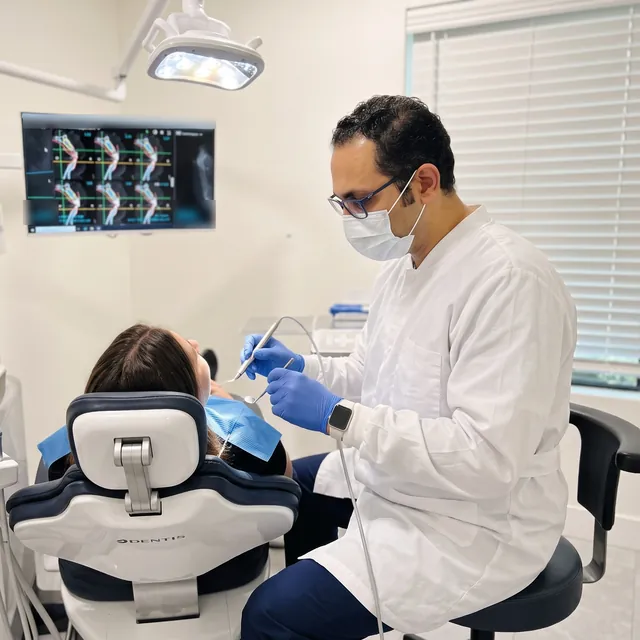
Scaling and Root Planing: The First Line of Defense Against Gum Disease
Scaling and root planing (SRP) is the foundational non-surgical treatment for periodontal disease. Unlike a standard prophylactic cleaning — which addresses deposits at and just below the gum margin — SRP reaches deep into periodontal pockets of 4 mm or greater to mechanically remove calcified bacterial deposits (calculus) and infected cementum from the root surfaces. This debridement eliminates the bacterial reservoir driving the chronic inflammatory process that destroys bone and attachment around affected teeth.
At ADSC, SRP is performed under local anesthesia using a combination of ultrasonic instrumentation (for efficient bulk deposit removal) and hand instruments (Gracey curettes for precise root surface debridement). Treatment is typically completed in two visits, treating one half of the mouth per appointment. This phased approach allows thorough instrumentation without prolonged appointment times and gives the treated side time to begin healing before the second side is addressed.
The clinical success of SRP is measured at a reevaluation appointment four to six weeks later. Probing depths are reassessed. Pockets that have reduced to 3 mm or less with no bleeding represent successful treatment. Pockets that remain deep or continue to bleed may require additional localized treatment — including locally delivered antimicrobials or surgical intervention. Patients then transition to a periodontal maintenance schedule (every three to four months) to prevent disease recurrence.
Serving Beaverton, Aloha, Hillsboro & Washington County
Aloha Dental Specialty Center is located at 18455 SW Alexander St, Suite B, in Beaverton, Or Oregon. We serve patients from across the Tualatin Valley and greater Portland metro, including Aloha, Hillsboro, Tigard, Lake Oswego, and Tualatin. Our Beaverton office is a 5-minute drive from Aloha, 10 minutes from Hillsboro, and 15 minutes from Tigard via SW 185th Avenue.
-
📍
Intel Campuses (Ronler Acres & Jones Farm)
10 to 15 minutes via NW 185th Ave. We accommodate the schedules of tech professionals who need efficient, high-quality specialty care.
-
📍
Nike World Headquarters
About 8 minutes via SW Baseline Rd. We frequently see patients from the Nike campus for surgical and implant procedures with sedation options.
-
📍
Streets of Tanasbourne & Orenco Station
Easily accessible via US-26 and NW 185th. Local general dentists in these communities regularly refer patients to us for specialty procedures.
Why Local Dentists Refer to Us
We work as a trusted partner to general dentists throughout the Tualatin Valley. When cases require CBCT-guided planning, IV sedation, bone grafting, or other advanced procedures, local providers refer to Dr. Ostovar for his experience with implant procedures and predictable results.
We handle the procedures within our scope and coordinate closely with your general dentist for seamless continuity of care from start to finish.
Office hours: Mon–Fri 8 AM–5 PM (Thu & Fri until 6 PM), Sat 8 AM–2 PM
Understanding Your Investment
At Aloha Dental Specialty Center, we provide transparent pricing before any treatment begins. The cost of your procedure depends on clinical complexity, materials used, and sedation requirements. We walk you through every line item during your consultation so there are no surprises.
What Affects Cost:
- Clinical Complexity: Bone loss, sinus proximity, nerve involvement, or the need for grafting affects treatment planning and surgical time.
- Materials: We use research-backed implant systems, purified bone graft matrices, and high-strength ceramics from established manufacturers.
- Sedation: Options range from local anesthesia to IV sedation, each with different associated costs. We discuss the best option for your comfort and procedure.
Insurance & Financing
We accept most major dental insurance plans and file claims on your behalf. Our team verifies your benefits before treatment and submits pre-treatment estimates with clinical documentation to maximize coverage.
For out-of-pocket costs, we partner with CareCredit and Cherry for flexible payment plans. We also offer our ADSC Dental Savings Plan for patients without insurance.
Most patients complete their scaling root planing deep cleaning appointment in 45-90 minutes. Complex cases may require 1-2 hours. Your initial consultation takes about 60 minutes including imaging and treatment planning.
Recovery & Healing Timeline
Understanding the healing process helps you plan ahead and follow post-operative instructions for the best possible outcome.
First 48 Hours
Mild swelling and tenderness are normal. Apply ice packs in 20-minute intervals and take prescribed or over-the-counter anti-inflammatory medication. Eat soft foods and avoid the surgical site when chewing.
Days 3 to 7
Swelling peaks around day three and then improves. The tissue begins closing over the surgical site. Continue with soft foods and use any prescribed antimicrobial rinse. Most patients return to normal activities during this phase.
Long-Term Healing
Surface tissue heals within two to three weeks. Bone integration and deep healing continue for three to six months. Avoid smoking, follow up as scheduled, and maintain good oral hygiene throughout recovery.
Questions during recovery? Call us at (503) 822-0096. We are available for post-operative concerns.
Subgingival Biofilm Disruption and Root Surface Detoxification
The pathogenic biofilm within a periodontal pocket is a highly organized polymicrobial community embedded in an extracellular matrix that protects constituent bacteria from both the host immune system and systemic antibiotics. Mechanical disruption through scaling and root planing is the most effective method of biofilm elimination because it physically removes the structured community and its protective matrix. Root planing extends this disruption by removing the layer of contaminated cementum that contains embedded endotoxins (lipopolysaccharides) — bacterial byproducts that perpetuate the inflammatory response even after living bacteria are removed. Detoxification of the root surface creates a biologically compatible substrate for periodontal ligament cell reattachment and reduces the chemotactic stimulus driving neutrophil infiltration and tissue destruction. Ultrasonic instruments (piezoelectric or magnetostrictive) create acoustic streaming and cavitation effects within the pocket that disrupt biofilm and flush debris, complementing the direct mechanical action of the instrument tip. The combination of ultrasonic debridement and hand instrumentation produces superior clinical outcomes compared to either modality alone.
Why Choose ADSC?
Scaling and root planing at ADSC is performed by clinicians trained in periodontal instrumentation techniques, using a combination of ultrasonic and hand instruments calibrated to each patient's pocket architecture. Treatment planning follows the 2018 AAP staging classification — SRP is indicated for Stage I-II periodontitis (and as initial therapy for Stage III-IV before surgical decisions are made). Reevaluation at four to six weeks provides objective data (probing depth changes, bleeding on probing) to assess treatment response and determine whether additional intervention is needed. Patients with dental anxiety receive nitrous oxide or IV sedation to ensure treatment is completed thoroughly without discomfort-driven interruptions.
Treatment time varies by complexity. A straightforward procedure may take 30-60 minutes, while more involved cases can take 1-2 hours. Your consultation visit typically lasts 45-60 minutes including imaging and treatment planning. We’ll give you a specific time estimate for your individual case.
Your Scaling Root Planing Deep Cleaning Treatment Steps
- Consultation & Exam: Comprehensive scaling root planing deep cleaning evaluation with CBCT 3D imaging at our Beaverton office.
- Treatment Plan: Our experienced dental team discusses your scaling root planing deep cleaning options, timeline, and costs. We use advanced 3D imaging and evidence-based protocols across general dentistry, endodontics, and pediatric care.
- Treatment: Procedure performed with comfort options including sedation if needed.
- Follow-Up: Post-treatment monitoring and care coordination for optimal healing.
Schedule Your Appointment Today
Book a consultation with our team at Aloha Dental Specialty Center in Beaverton, OR. Call (503) 822-0096 Office hours: Monday through Friday 8 AM to 5 PM (until 6 PM Thursday and Friday), Saturday 8 AM to 2 PM. or request an appointment online.
Related Services at Aloha Dental Specialty Center:
Dental Implants · Oral Surgery · Root Canal · Invisalign · Periodontics · Pediatric · TMJ Treatment · Sedation · Cosmetic · Emergency · Sleep Apnea
A Note from Your Dental Team
In my experience, the patients who get the best results from scaling root planing deep cleaning are those who come in with realistic expectations and follow their post-treatment instructions carefully. I’d rather spend extra time explaining what to expect than have a patient be surprised later.
“Every patient I see has a different story, a different set of concerns, and a different definition of what ‘success’ looks like. That’s why I don’t believe in one-size-fits-all treatment plans. When you come in for a consultation, I’ll listen first, examine second, and recommend third.
I also won’t recommend a procedure you don’t need. If your tooth can be saved with a filling instead of a crown, I’ll tell you that. If watchful waiting is appropriate, I’ll explain why. My job isn’t to sell treatment — it’s to give you my honest clinical judgment so you can make an informed decision.
If you have questions about whether this treatment is right for you, or if you’ve been told you need this procedure by another dentist and want a second opinion, call us at (503) 822-0096. We’re happy to take the time to explain everything — no rush, no pressure.”
— Dr. Merat Ostovar & Dr. Jovan Gvozden | Aloha Dental Specialty Center, Beaverton, OR
I know many patients feel anxious about dental procedures — you’re not alone in that. What I hear most often after treatment is: “That was so much easier than I expected.” We’re here to make this as comfortable as possible for you.
Are You a Candidate for Scaling Root Planing Deep Cleaning?
As with any dental procedure, there are potential risks including infection, temporary discomfort, and in rare cases, complications that require additional treatment. We minimize these risks through 3D imaging, sterile protocols, and careful case selection. During your consultation, we’ll discuss any specific risks related to your individual situation.
Most patients in good general health are candidates for scaling root planing deep cleaning. However, certain factors may affect your eligibility or require modifications to the treatment plan:
- Medical conditions: Uncontrolled diabetes, autoimmune disorders, or blood-thinning medications may require coordination with your physician before treatment.
- Bone quality: For scaling root planing deep cleaning involving the jawbone, adequate bone density is essential. A CBCT 3D scan during your consultation determines this precisely.
- Smoking: Tobacco use significantly impairs healing. We strongly recommend quitting 2-4 weeks before and after any surgical procedure.
- Age: There is generally no upper age limit. What matters is your overall health, not your age. We have successfully treated patients in their 80s and 90s.
The only way to know for certain is a consultation with our team with a board-certified endodontist. Call (503) 822-0096 to schedule your evaluation — we’ll tell you honestly whether this is the right treatment for your situation.
Typical Healing Timeline:
Days 1-3: Initial healing, mild swelling managed with ice and medication. Days 4-7: Swelling subsides, gradual return to normal diet. Weeks 2-4: Soft tissue heals completely. Months 2-6: Bone remodeling and full integration (for surgical procedures). Individual recovery varies — we provide detailed post-op instructions specific to your procedure.
For additional clinical information, visit the American Dental Association (ADA).
Reviewed by Dr. Walied Eldomiaty, DDS, Periodontist — March 2026. Clinical information on this page reflects current evidence-based dental practices.
Related Dental Services
Frequently Asked Questions
A regular prophylaxis removes deposits from above the gum line and slightly below in a patient with healthy gums. Scaling and root planing is a therapeutic procedure performed under anesthesia in a patient with diagnosed periodontal disease — it reaches deep pockets (4+ mm), removes embedded calculus from root surfaces, and debrides infected tissue. Different conditions, different procedures, different purposes.
Local anesthesia numbs the treatment area completely, so the procedure itself is not painful. Post-treatment, teeth may be sensitive to cold for one to two weeks as the gum tissue heals and tightens around the roots. Mild gum soreness is common for a few days. Over-the-counter pain medication and desensitizing toothpaste manage these symptoms effectively.
Typically two appointments — one for each side of the mouth (upper and lower right, then upper and lower left). Each appointment takes 60 to 90 minutes. Treating half the mouth per visit allows thorough instrumentation without fatigue and enables the first side to begin healing before the second is treated. Patients with milder disease may complete treatment in a single visit.
Minor bleeding and oozing on the day of treatment is normal. This should resolve within 24 to 48 hours. As the gums heal over the following weeks, they become firmer and less prone to bleeding during brushing and flossing — which is the goal. If bleeding gums were a pre-treatment symptom, you should notice significant improvement within two to three weeks.
Gum inflammation and bleeding typically improve within two to three weeks. Reduced puffiness and tighter gum tissue become noticeable as healing progresses. Pocket depth reduction is measured at the reevaluation visit four to six weeks after treatment. Freshened breath and improved gum color are commonly reported within the first month.
Yes — if probing depths and radiographs indicate periodontal disease. Periodontal disease is overwhelmingly painless in its early and moderate stages. Pain typically only occurs with advanced disease (abscess, severe mobility, or acute infection). Waiting for pain means waiting until significant, irreversible bone loss has already occurred. Treatment is most effective when initiated before symptoms appear.
SRP does not regenerate lost bone, but it halts the progression of bone loss by eliminating the bacterial infection driving it. Gum tissue does tighten and reattach to treated root surfaces, reducing pocket depths. Bone regeneration requires surgical procedures (guided tissue regeneration) for specific defect types. SRP's primary value is stopping the disease process before bone loss becomes severe enough to compromise tooth viability.
Continue brushing (gently around treated areas for the first few days) and flossing. Use a chlorhexidine antimicrobial rinse if prescribed — it suppresses bacterial regrowth during the initial healing phase. Avoid smoking, which dramatically impairs healing. Eat soft foods on the day of treatment. Sensitivity to cold is managed with desensitizing toothpaste containing potassium nitrate.
Cost is typically calculated per quadrant (quarter of the mouth). Most dental insurance plans cover SRP as a basic periodontal service at 80 percent. The front desk provides a detailed cost estimate based on your insurance coverage before treatment begins. For uninsured patients, the per-quadrant cost is a fraction of the expense associated with the tooth loss that untreated gum disease eventually causes.
Not always. Many patients achieve adequate disease control with SRP alone, particularly those with Stage I-II disease. Reevaluation after SRP determines whether residual pockets (5+ mm with bleeding) require surgical intervention. Approximately 10 to 20 percent of sites that do not respond to non-surgical therapy may benefit from pocket reduction surgery or regenerative procedures.
No. Systemic antibiotics cannot penetrate organized subgingival biofilm effectively — the biofilm's extracellular matrix shields bacteria from antibiotic concentrations achievable in gingival crevicular fluid. Antibiotics are sometimes used as an adjunct to SRP (not a replacement), delivered locally into treated pockets or systemically for aggressive disease patterns. Mechanical biofilm disruption remains the essential first step.
Periodontal maintenance visits every three to four months replace the standard six-month recall. This frequency is necessary because pathogenic bacteria recolonize treated pockets within three to four months. Maintenance visits include probing reassessment, localized re-instrumentation of any recurrent pockets, and full-mouth biofilm removal. This schedule is maintained long-term — periodontal disease is controlled, not permanently eliminated.
Yes. Local anesthesia is standard for all SRP procedures. Patients with dental anxiety can receive nitrous oxide for additional relaxation or IV sedation for a completely comfortable experience with no awareness of the procedure. The sedation option is discussed during the treatment planning visit and selected based on patient preference and anxiety level.
No. The instruments remove disease-causing deposits and infected root surface cementum — not healthy tooth structure. Root sensitivity after treatment occurs because the previously disease-covered root surface is now exposed to temperature changes in the mouth. This sensitivity resolves as the gum tissue heals and tightens. No permanent damage to tooth structure occurs from properly performed SRP.
Periodontal disease is progressive and does not self-resolve. Without treatment, pockets deepen, more bone is lost, teeth become increasingly mobile, and the infection can spread to adjacent teeth. Over time, the prognosis for affected teeth worsens from treatable to questionable to hopeless. The cost of treating advanced disease — or replacing lost teeth with implants — dramatically exceeds the cost of early SRP intervention.